The Alberta EMS Wellness Survey: This is How It Ends.


Road Sign Ahead.
After years of assuring everyone that morale was improving, engagement was increasing, and everything was moving in exactly the right direction, Alberta EHS leadership did something unexpectedly brave.
They asked paramedics what they actually thought.
Even more surprisingly, we've managed to review the results before they're transformed into an EHS PowerPoint presentation explaining this as "Opportunities for Growth."
For years, wheresmyambulance.com has operated on a fairly simple hypothesis: that the biggest threat to Alberta EMS isn't a lack of dedication from frontline paramedics, but a chronic shortage of competent leadership.
It's a bold claim.
Fortunately, leadership collected the evidence for us.
The results are... illuminating. Basically it looks like this!

Before we get into it, we ask you to please stick around until the very end of the article. We have a short, important announcement of our own. Unlike most leadership announcements, this one won't require creative interpretation of the data.
1,147 paramedics, most of them experienced frontline staff with over a decade on the job, responded to the wellness survey. You'll see below that the average respondent has well over a decade on the job. Seasoned professionals who've seen enough to know the difference between an isolated bad day and a deeply entrenched toxic organizational culture.


So, what do these experienced paramedics have to say about the people entrusted to lead them? In an unexpected twist that anyone who was paying attention saw coming, it isn't glowing.
When asked, "I am asked for suggestions on how to do my best work," 41.33% of paramedics strongly disagreed, while another 22.15% somewhat disagreed. At the opposite end of the spectrum, a staggering 2.28% strongly agreed. Apparently, seeking input from the people actually doing the job remains an innovative concept.
There's a certain irony here. These front-line staff are the very people who could help insulate leadership from its own worst ideas, offering practical insight before plans evolve into fully involved dumpster fires. Unfortunately, that would require asking them.
Instead, "leadership" recently took what can only be described as a victory lap, reporting to the Province that its Help-U project achieved a 90% success rate, repeated with a straight face in public statements to MLAs.
Naturally, we checked the math. By our calculations, it was closer to 81%.
That figure also deserves more context. Between March 17 and June 10, 2026, Help-U resources were dispatched to a meagre 1% of all calls. Declaring victory after reaching 1% of the workload is certainly one approach. It's just not one most people would mistake for meaningful system-wide success.
Perhaps this helps explain why so many experienced paramedics don't feel their opinions are sought or valued. When the people with decades of frontline experience aren't being heard, organizations tend to become very good at congratulating themselves while solving remarkably little. Below is our FOIP on the Help-U project.

If that wasn't bleak enough, respondents were also asked whether "I am treated with respect by my organization." Here, 25.31% somewhat disagreed, while another 23.03% strongly disagreed. Nearly half of the respondents don't believe they're treated with respect by the very organization that depends on them.
Those aren't just bad numbers, they're the kind of numbers that would prompt most leadership teams to engage in some serious self-reflection. Or, failing that, commission another survey to find out why everyone keeps giving them bad survey results.
Meanwhile, only 6.04% of paramedics strongly agreed that they are treated with respect by their organization. It's difficult to inspire confidence when "feeling respected" performs worse than the average weather forecast.

This was probably the least surprising result in the entire survey.
After all, this is the same leadership team that put someone who hasn't worked on an ambulance in years together with someone who's never worked on one at all to redesign the uniform. The goal? To look "more European" and "less like police." The result? A logo and name that left many wondering whether anyone had consulted paramedics.
Technically, they had. They reportedly presented people with two bad options and called it consultation.
The backlash was so significant that even the Government of Alberta stepped in to ask if this was really the plan. When the government is asking whether you've consulted the people doing the job, it's a fair indication that something has gone spectacularly sideways. (https://globalnews.ca/news/11898985/ahs-ambulance-paramedic-rebrandinge-provider/)
The next statement was, "I receive recognition for a job well done." The results were, once again, less than flattering. A total of 36.6% of paramedics strongly disagreed, while another 24.61% somewhat disagreed. Meanwhile, just 4.03% strongly agreed.
You can't help but wonder how the numbers would look if the statement had been reversed to: "I receive discipline for the slightest misstep." That might be the survey where leadership really shines.
Because, judging by these results, and the experiences many paramedics describe, recognition appears to be in critically short supply, while disciplinary enthusiasm from supervisors remains a resource that never seems to run out.


Then came the statement, "I trust the leadership beyond my direct supervisor at my organization." Nearly half, 48.16%, of paramedics strongly disagreed, while another 23.47% somewhat disagreed. Those aren't just poor numbers; they're the kind that suggest trust is non-existent throughout the organization.
The survey also asked whether "My organization is committed to employee health and well-being." Here, 37.04% strongly disagreed, with another 27.58% somewhat disagreeing. For a wellness survey, that's a remarkably unhealthy result.
Perhaps overlooking issues like alleged dispatch retaliation and other frontline concerns isn't the strongest way to convince employees that their well-being is a priority. Then again, judging by these numbers, the workforce seems to have already reached that conclusion.

When asked whether "My organization values my contributions," 40.89% of paramedics strongly disagreed, while another 23.82% somewhat disagreed. Just 2.98% strongly agreed.
It's a difficult statistic to reconcile with an organization that regularly describes its people as its greatest asset. Apparently, many of those assets don't feel particularly valued. Perhaps they're appreciating them the way people appreciate smoke detectors, only noticing them when something goes wrong.

When asked whether "My organization invests a lot of time and money into safety training for employees," 26.01% of paramedics strongly disagreed, while another 23.38% somewhat disagreed. Just 2.98% strongly agreed.
It's not difficult to see why.
One example is the organization's reliance on CPI's Nonviolent Crisis Intervention training. It's a perfectly reasonable program, for schools, hospitals, long-term care, and other controlled environments. An ambulance at three o'clock in the morning, on the front lawn of someone actively trying to assault you, is not a controlled environment.
The irony is that the research on violence against paramedics increasingly points toward the need for EMS-specific training: recognizing escalating violence early, knowing when to disengage, coordinating with police, and, perhaps most importantly, understanding that no patient is worth getting stabbed over.
Teaching frontline paramedics a course designed primarily for institutional settings is a bit like preparing firefighters by showing them videos of birthday candles. Technically, both involve fire. Judging by the survey results, many paramedics have already reached the same conclusion.

When asked whether "I seem to have enough time to complete tasks related to job requirements such as training or committee involvement," 28.55% of paramedics strongly disagreed, while another 21.02% somewhat disagreed.
Hardly surprising.
Finding time for training, committees, and professional development is challenging when paramedics are buried under a never-ending avalanche of emails, mandatory online courses that few people have the time, or enthusiasm, to complete, and requirements like PDIC every two years. All of this, naturally, is expected to happen during regular shifts while simultaneously responding to calls, waiting in hospital hallways, and enjoying the 'abundant free time' created by a healthcare system operating constantly at full capacity.
Apparently the ideal training environment is somewhere between a computer screen, a stretcher in a hallway, and the ongoing system-wide operational crisis with no meaningful solutions from the "leadership" team.

The survey then turned to paramedics' mental health, and this is where the results become genuinely sobering. If there is one area where leadership should have set aside its ego and focused entirely on stewardship, it is here. Instead, the findings suggest a workforce carrying the consequences of years of poor decisions, rampant system wide dysfunction and misguided priorities that serve leadership first.
When asked, "Are you limited in the kind or amount of work you can do because of a physical, mental, or emotional problem?" only 47.99% of paramedics answered "Not at all." Another 7.79% selected "Does not apply," while 11.91% did not respond. Of those who did answer the question, the remainder reported being limited to some degree, from slightly to extremely.
For an organization responsible for the health of both its employees and the public, those are alarming numbers. They describe a workforce under significant strain, not one that is thriving.
The tragedy isn't simply that so many experienced paramedics are struggling. It's that these results should surprise no one. They are the predictable outcome of a system where operational performance has too often taken priority over the people expected to hold it together.

The picture becomes even more concerning when the survey asks about how paramedics have been feeling over the previous two weeks.
When asked, "Over the last two weeks, how often have you felt down, depressed, or hopeless?" only 35.55% answered "Not at all." Meanwhile, 52.27% reported feeling that way on several days, more than half the days, or nearly every day.
The same pattern emerged when respondents were asked, "Over the last two weeks, how often have you felt nervous, anxious, or on edge?" and "Over the last two weeks, how often have you had little interest or pleasure in doing things that you typically enjoy?" The results were within only a few percentage points of one another.
At that point, it's difficult to dismiss the findings as an anomaly. Three separate questions, all measuring different aspects of mental well-being, arrive at essentially the same conclusion: a substantial proportion of Alberta's paramedics are struggling.
For the leadership team that commissioned this wellness survey, the results are remarkably clear. The only remaining question is whether they'll treat them as a call to action or simply another document to file away until the next survey confirms exactly the same thing.

Some people, including no doubt, the "leadership" team, will suggest that questions such as "Over the last two weeks, how often have you not been able to stop or control worrying?", "How often do you experience stress related to your family or social relationships?", or "How often do you experience stress related to your health?" have little to do with the workplace.
That is not a convincing argument. Unfortunately for them, the survey didn't stop there.
The very next question asked, "How often do you experience stress related to your work?" The responses were difficult to ignore: 22.33% answered often, 21.28% very often, 12.96% always, and another 21.72% sometimes. In total, 78.29% of respondents reported experiencing work-related stress in their personal life at least sometimes.
By comparison, just 0.7% said never, 3.24% almost never, and 5.52% rarely.
Viewed together, the pattern is hard to dismiss. The survey doesn't paint a picture of a workforce whose stress exists independently of the job. It paints a picture of a workforce whose job is one of its primary sources of stress.
Leadership commissioned this survey. These aren't our conclusions, they're the conclusions drawn from their own data. The only thing more remarkable than the results would be pretending they don't point to a systemic problem.


When asked, "How often do the demands of your job interfere with your personal life?" the results are indicative of a system that is anything but healthy.
A well-functioning organization should expect those numbers to be relatively low. Instead, 7.97% of paramedics answered always, 18.21% very often, 22.94% often, and 23.73% sometimes. In other words, nearly three-quarters of respondents reported that work intrudes on their personal lives at least some of the time.
There will undoubtedly be those who dismiss this as nothing more than the occasional late call or missed meal break. But taken alongside everything else in this survey, that explanation falls apart.
This isn't just about finishing late. It's about working in a system whose dysfunction doesn't end when the shift does. The operational failures, chronic staffing pressures, and relentless stress follow paramedics home, long after the ambulance has been restocked and handed over to the incoming crew.
For years, "leadership" has argued that criticisms of the system are taken "out of context." Ironically, this survey provides exactly that context, and it's their own data showing that the consequences of their incompetent decisions don't stop at the station door.

We can say that with some confidence because the next set of questions begins to separate the stress that comes with being a paramedic from the stress created by the system itself.
Yes, EMS is inherently stressful. People's lives are in paramedics' hands. That's the job. But the survey wasn't just measuring the stress of patient care, it was measuring the stress of how the system operates.
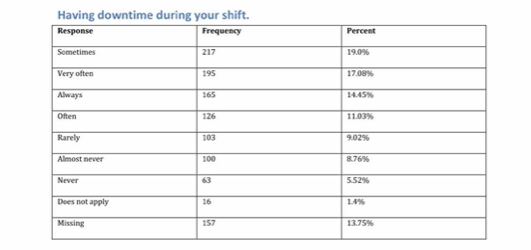
When asked about "Having downtime during your shift," 19.00% said it was sometimes a source of stress, 11.03% often, 17.08% very often, and 14.45% always. By contrast, the respondents who said this was rarely, almost never, or never a source of stress each made up only single-digit percentages.
Think about that for a moment. In most professions, downtime is something people look forward to. In Alberta EHS, it's become something people worry about.
That's not a feature of emergency medicine. It's a symptom of a system where crews have learned that any moment of calm is probably just the prelude to the next operational disaster.
The same pattern appeared across several other operational questions.
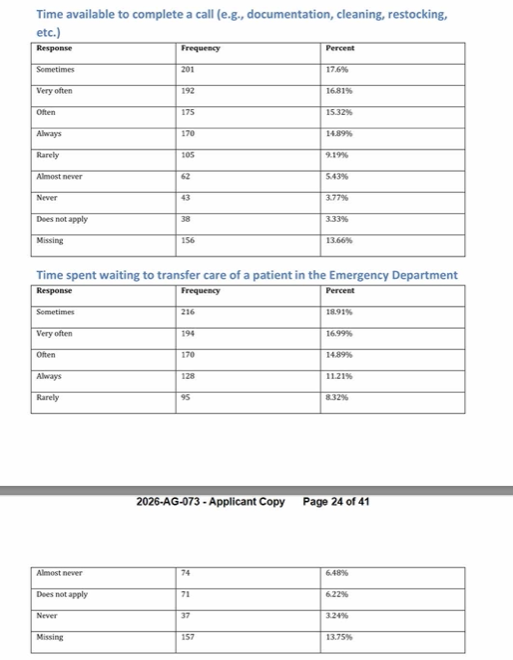
"Time available to complete a call" was identified as a source of stress by 17.60% of respondents sometimes, 15.32% often, 16.81% very often, and 14.89% always. Once again, those reporting rarely, almost never, or never were confined to single-digit percentages.
The results were strikingly similar for "Time spent waiting to transfer care of a patient in the Emergency Department" and "Meeting operational performance indicators." These aren't isolated frustrations, they're recurring themes throughout the survey.
Then there was "Your shift partner." Anyone who's spent time in EMS knows that your partner can make or break a shift. It's perhaps the least surprising entry in the survey, but it also serves as a reminder that when people are exhausted, overworked, and operating in a chronically strained system, even relationships that should be a source of support can become another source of stress.
By this point, a pattern is impossible to ignore. The survey isn't describing a profession that's simply demanding. It's describing an organization where many of the biggest stressors are operational, predictable, and, in principle, fixable.


Perhaps the most revealing finding is where the responses stop following the general pattern and become significantly more emphatic.
When asked about the "Number of EMS resources available to respond," the results shifted dramatically. A full 25.57% of paramedics said this was always a source of stress, while 24.43% said very often. Another 12.26% answered often, and 11.91% sometimes.
The opposite end of the scale barely registered. Responses of rarely, almost never, and never all remained in the single digits, ranging from just 1.66% to 4.29%.
That's a remarkable departure from the other operational questions. This isn't an occasional frustration or an inconvenience that flares up now and then. For roughly half of respondents, having too few EMS resources is an almost constant source of stress.
If leadership wanted to identify the system's biggest operational problem, they didn't need another consultant. Their own survey found it for them.

Those results come at a time when the staffing crisis has become impossible to ignore.
In just the first few months of the year, Alberta EMS spent more than $11.5 million on overtime, yet still could not reliably staff every ambulance or prevent recurring Red Alerts. Throwing more overtime at the problem hasn't solved the underlying shortage, it has simply made an expensive problem even more expensive, and burnt out Paramedics in the process.
The situation became even more apparent during the Calgary Stampede. Despite offering overtime and opening shifts to staff from across the province, Calgary Zone reportedly filled only 69% of its transport-capable metro units for the first Saturday day shift of the event. If that's how the system starts one of the busiest weeks of the year, it's difficult to imagine anyone believing the remainder of the event improved.
For years, leadership has described staffing as a challenge. The people working in the system would probably describe it as something else entirely. When half your workforce says that a lack of available EMS resources is an almost constant source of stress, and the operational data points in exactly the same direction, it's no longer a perception problem. It's a capacity problem, and when double time isn't enticing enough to fill all the holes in the system then the system is profoundly broken.


One thing that's impossible to ignore in this spectacularly dysfunctional operational dumpster fire is this: in a profession like EMS, you'd assume the biggest source of stress would be the patients. That's certainly the public perception. And yes, there are plenty of stressful situations involving patients. If a patient files a complaint, no matter how spectacularly frivolous, you can safely expect a supervisor to be in touch.
Ironically, though, patient condition itself isn't what Paramedics report as stressing them the most.
According to this survey, only 14.62% of Paramedics said patient condition often causes them stress, while a mere 4.73% said it always does. 28.63% reported it sometimes causes stress, and 13.57% said rarely.

Those numbers prompted an obvious question: why? Could it be that "leadership" has successfully transformed EMS from a public safety service into an underfunded, overbooked taxi company with medical equipment? Could it be that the operation itself has become a greater source of stress than the people it's supposed to serve? Is the system generating more cortisol than patients?
Don't worry, that last question was rhetorical. We already know the answer. It's just impolite to print it in all caps. We already know book offs from exhaustion and stress are already sky high. So that became the perfect segway into the next batch of data points we found significant. When asked whether ending their shift on time was a source of stress, the responses painted a fairly bleak picture. 37.3% of respondents said it always causes them stress, while another 13.57% said it usually does. Before we've even finished adding up the numbers, more than half of respondents are already telling us that getting home on time is more aspiration than expectation. Add 7.71% who said it is often a stressor and 11.38% who said sometimes, and the trend becomes difficult to ignore.

Viewed alongside the previous findings, it's hard not to imagine how demoralizing this must be. Most Paramedics know exactly why they've just been handed mandatory overtime. They're told the call is too critical to wait, only to arrive and discover that the "emergency" could likely have been resolved with a visit to a walk-in clinic and a leisurely stroll through Shoppers Drug Mart.
Apparently, in today's EMS model, "life-threatening emergency" has become an impressively flexible term. Speaking of book-offs, let's look at another telling data point.
Paramedics have lives outside the ambulance, or at least they're theoretically supposed to. In a system this dysfunctional, time away from work isn't a luxury; it's maintenance. So, how do Paramedics feel about getting that time off?
The answer is revealing. 25.74% of respondents said obtaining time off is always a source of stress. Another 13.84% said very often, 9.28% said often, and 11.82% said sometimes. Those who reported never worrying about getting time off? Just 4.29%.
In a profession that places this level of strain on its workforce, these numbers are hardly shocking. Consider the frequency of sick calls, or the fact that, during parts of last summer, some zones were operating with barely 50% of their ambulances available.
The other half? Good question. Maybe EHS "leadership" can try to answer that some day without any spin that smells like we're covering our ass because we have no idea what we are doing.

Need another explanation for why book-offs are so common? Here's one that practically hangs a flashing neon sign over the workplace reading, "Toxic Environment."
Consider the simple question: "My partner."
In EMS, you're part of a public safety service where trust, teamwork, and strong working relationships aren't just nice to have, they're essential. You rely on your partner to make good decisions, to have your back when things go sideways, and occasionally to tolerate your terrible coffee. You'd expect that working alongside another Paramedic would be a source of confidence, not anxiety.
Yet Alberta EHS tells a different story.
15.5% of respondents said they always feel stressed about who they'll be working with. Another 16.73% said very often, 10.42% said often, and 15.85% said sometimes.
Now look at the other end of the scale. Only 9.11% said they rarely worry about it, 3.24% said almost never, and just 1.92% said never.

Think about that for a moment. In an organization built on teamwork, finding out who your partner is has become a source of stress for far more people than a source of reassurance.
That's not a personality problem. That's an organizational one. What's the story behind those numbers, you ask?
Well, we can only go on the mountain of "anecdotal" evidence. You know, the countless DMs, emails, phone calls, hallway conversations, coffee chats, and the occasional thousand-yard stare from exhausted Paramedics. Other than that, we've got absolutely nothing.
The formula seems fairly straightforward. Create an environment where rolling over on your partner for what most reasonable people would call a minor issue isn't just encouraged, it's practically a team-building exercise. Somewhere, an HR policy probably calls it "psychological safety." Everyone else calls it Tuesday.
EHS has somehow mastered the art of rewarding behaviour that predictably detonates morale. And considering morale has already been tunnelling toward the Earth's core for years, that's an impressive achievement. It takes real dedication to keep lowering the bar after it's already on the floor.
Armed with the latest anonymous tip-off, management eagerly launches into its favourite pastime: investigations. Individually they'll tell you they hate doing them. Collectively, however, they pursue investigations with the enthusiasm of people who've just discovered a new hobby. Nothing says "healthy workplace culture" quite like another interview room and another stack of paperwork.
Meanwhile, the people and the operation as a whole pays a significant price.
But don't take our word for it. Ask The Paramedics. They're the ones living it. Now, let's look at the other end of the spectrum.
After years of neglect, questionable decisions, and the sort of strategic planning that makes people wonder if the models were written on a pub napkin, many seasoned Paramedics looked around and came to the same conclusion:
"Yeah... I'm out."
That created a massive experience gap. So who fills it?
New hires.
And what's missing now with the best mentors gone? Decades of operational knowledge, clinical judgement earned through thousands of calls, or the instincts that only experience can teach. That's not a criticism of new Paramedics, every experienced Paramedic was once new. The problem isn't the rookies. The problem is expecting them to replace twenty years of experience after a few weeks of orientation and a handshake.
Who mentors them when many of the mentors have already left?
Exactly.
Think that doesn't add stress to every shift? Think again.
Instead of valuing, retaining, and properly compensating the experienced Paramedics whose knowledge can't simply be downloaded into the next recruit, leadership made the workplace so unbearable that many of those people left. Then, rather than fixing the conditions that drove them away, the solution was to keep hiring replacements and hoping for the best.
It's a fascinating workforce strategy. If your goal is to build a resilient, experienced ambulance service, it's difficult to imagine choosing the exact opposite approach more consistently.
The irony, of course, is that none of this should surprise anyone. You can't spend years treating experience like an inconvenience, replace institutional knowledge with turnover, foster a culture of suspicion instead of trust, and then act bewildered when morale, retention, and operational performance all decline together.
But perhaps another investigation will finally get to the bottom of it.
Finally, for us, at least, though certainly not the final piece of data—we wanted to touch on bullying and harassment.
If there was ever a statistic that perfectly captures just how dysfunctional and toxic this organization has become, this is probably it.
When asked whether a superior or coworker had put them down in the past year, 45.1% of respondents answered yes. Another 5.87% weren't even sure.
Think about that for a second.
In a healthy workplace, "Have you been put down by a coworker or supervisor in the last year?" shouldn't be a coin toss. Yet here we are.
Only 34.68% of respondents could confidently answer no.
That's... impressive. Not in the way you'd put on a recruitment poster, admittedly, but impressive nonetheless.

Apparently, fostering a culture of respect remains one of those "strategic priorities" that looks fantastic in a PowerPoint presentation and considerably less convincing in the real world. But on the bright side, at least everyone can attend another mandatory online module explaining why workplace respect is important. Those always solve deeply rooted cultural problems.
This paints a truly glowing picture of Alta... checks notes... Alberta EHS.
Easy mistake to make.
When respondents were asked a more direct question—whether they had personally been bullied or harassed by a superior or coworker in the past year—the results were, to put it mildly, not encouraging.
According to the data, roughly one in four Paramedics reported experiencing bullying or harassment in the workplace.
52.85% said no.
27.06% said yes.
Another 4.29% weren't even sure.
That last number deserves more attention than it gets. If someone isn't even sure whether what they experienced qualifies as bullying or harassment, it raises an uncomfortable question: has the behaviour become so commonplace that people no longer recognize it for what it is?
And that's before considering everything employees never see.
Take the case of former Edmonton Paramedic Summer Penny. By every reasonable measure, she was bullied out of her job. Someone who could very well still be serving Albertans today had she received genuine support, mentorship, and leadership, instead of whatever this organization insists on calling leadership.
When she approached us, we helped her file a Freedom of Information request regarding what had happened to her.
What came back was astonishing.
Not because we'd never seen anything like it before, but because even after hearing countless stories over the years, it still managed to surprise us. And that bar is, unfortunately, set embarrassingly high.
Nor is Summer's story unique.
We've helped others file similar requests, particularly surrounding workplace investigations. Many came to us knowing that simply talking about their experiences could put their careers at risk. Officially, they're investigations. Unofficially... well, "kangaroo court" seems to come up with surprising frequency.
The records people have received have, in many cases, painted a picture that goes well beyond poor management. They describe patterns of workplace bullying, harassment, and processes that some would argue resemble campaigns of constructive dismissal more than fair or impartial investigations.
The troubling part is that the people responsible almost certainly know who they are. Many will probably read this.
Whether it prompts a moment of reflection is another matter entirely.
After all, when you've spent long enough in a toxic swamp, eventually it just starts to feel like home. Well, here we are.
After thousands of words, hundreds of Freedom of Information requests, more emails than any reasonable person should ever have to read, and enough organizational dysfunction to qualify as its own branch of government, we've finally reached the end.
And perhaps the most shocking finding from this entire wellness survey isn't that paramedics are exhausted, frustrated, or losing faith in leadership.
It's that anyone is surprised.
For years, we've been told the problems were complicated. That change takes time. That concerns were being heard. That solutions were coming.
The province promised things would improve.
Instead, the problems became the improvement plan.
Staff shortages became normal. Burnout became expected. Toxic workplace culture became something to be managed rather than something to be fixed. Every crisis became a "challenge," every failure became a "learning opportunity," and every solution somehow required another committee, another consultant, and another announcement explaining how much progress was being made.
The wellness survey simply confirmed what paramedics have been saying for years. The system is struggling, the workforce is hurting, and the people responsible for fixing it appear to have perfected the art of congratulating themselves while the building continues to burn.
And yet, somehow, in the middle of all this, the organization found time to celebrate a milestone: an Executive Director becoming the first female Vice President of the Paramedic Chiefs of Canada. That is absolutely worth recognizing. Representation matters, and breaking barriers is important. There are many extraordinary female Paramedics out there who are doing amazing things. There just aren't any in executive roles within this organization if the data we've seen is to be believed.
Celebrating a historic appointment while the organization itself is in free fall feels a little like celebrating the installation of a new steering wheel while the vehicle has no brakes, three flat tires, and is currently rolling downhill toward the ocean. As for the Paramedic Chiefs of Canada, we've considered for years that they were just another dysfunctional, corrupt limb of the EMS body in Canada. In our opinion paramedics in Canada today are worse off as a result of their efforts.
The failures are real.
Because leadership titles do not fix broken systems. Press releases do not rebuild trust. And no amount of rebranding or AHS Media corporate messaging repeated by compliant journalists can convince frontline paramedics that everything is fine when their own experiences, and now their own survey responses, say otherwise.
Which brings us to our promised announcement.
This will be our final blog post.
After several years of operating Wheresmyambulance.com it's time for us to hang it up and focus on other projects.
When we started WMA, we never expected it would become what it did. We never expected the number of people who would reach out, share their stories, trust us with their experiences, or support what we were trying to accomplish. Many of the tips we received were from Paramedics who saw issues firsthand and sent us 'WTF?' messages.
We have received incredible support from people across Alberta, including those who donated money to keep this project alive. Many of you who excaped to BC, retired, were FIRED or moved on to less toxic careers all pitched in with a few bucks to help us keep moving forward. We cannot thank those people enough. Every donation, every message, every sticker request, and every person who quietly supported us mattered.
Speaking of stickers, we have to admit there's something strangely satisfying about knowing our little project sent thousands of them across Alberta. Somewhere out there, there are paramedic vehicles, lockers, coffee rooms, and probably a few places management would prefer not to look that are carrying a reminder that someone was paying attention.
But after years of fighting, researching, writing, requesting documents, and trying to hold people accountable, the reality is simple: We didn't move the needle far enough.
Alberta EMS leadership has remained so consistently dysfunctional that exposing their incompetence almost became a full-time job for 3 retired guys who were supposed to be enjoying having nothing do.... That's the irony.
We started this because we thought shining a light on problems might help fix them.
We won't apologize, we didn't fail anybody. We took a shot, did our best.
We were occasionally able to help. We gave people a voice when they felt they didn't have one. We made Alberta EMS leadership more a little uncomfortable when what they deserved was to be fired.
And yes, we made a few people laugh along the way. Some of this was hilarious.
Because if there is one thing we've learned after all these years, it's that sometimes the only appropriate response to organizational chaos is to request the records, document it carefully in a readable fashion and occasionally make a joke about this dumpster fire.
This is where we sign off.
Thank you to the paramedics who continue showing up every day despite everything placed in their way. You are magnificent.
And to Alberta EMS leadership:
We won't be watching anymore.
Which, frankly, may be the first bit of relief you've had from us in years.
But the Paramedics know what's going on and they're always watching.
Good luck. You're going to need it.


Comments