Robbing Peter, Paul, and the Entire North Zone

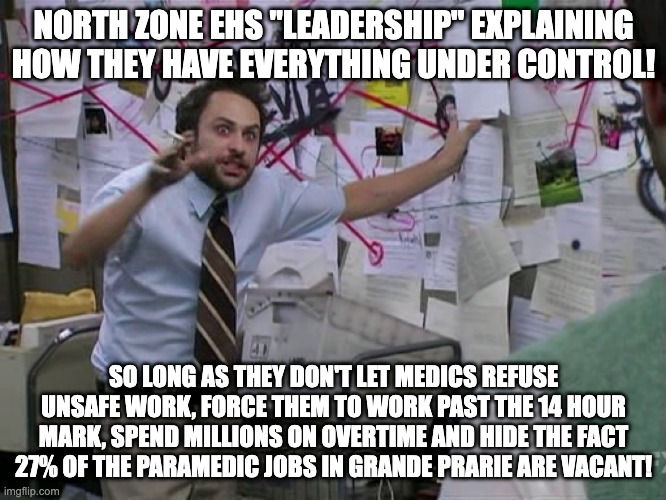
Welcome back to Alberta’s North Zone.Unfortunately.
If you’re new here, buckle up. If you’ve been here before, you already know how this goes: we look at the data, leadership assures everyone things are improving, and then the numbers kick that narrative straight down the stairs.
This latest deep dive wasn’t inspired by vibes, rumours, or “a feeling in the room.” It was inspired by FOIP data, you know, the stuff that costs real money, takes real time, and tends to make senior leadership very uncomfortable when citizens read it out loud. And yes, before anyone asks, no: FOIP requests are not free. Shocking, we know. Transparency apparently has a cover charge.
That’s why we’re going to say this early and often: if you value this work, if you value independent scrutiny of a system that keeps insisting everything is “stable” while quietly collapsing, consider supporting it. Even a small donation helps keep the FOIP machine running and the receipts flowing.👉 https://www.givesendgo.com/GC4M8
Now, back to the North Zone, where “innovation” means rebranding staffing shortages, “stability” means thousands of shutdowns, and Grande Prairie continues its role as the beating heart of system-wide dysfunction.
We wish this story had a happy ending. It does not.
The first time we wandered north to take a look at how things were going, we weren’t just surprised, we were genuinely alarmed. This was where our interest was first piqued by an initiative with a very cool, very corporate name: “Strike Teams.” You know, the plan where medics from all over the province were flown north to plug a few holes in a ship that was already taking on water faster than the Titanic, except with fewer lifeboats and a much higher consulting budget.
If you don’t remember that debacle, never read it, or successfully repressed it for mental health reasons, we recommend a refresher here:https://www.wheresmyambulance.com/post/strike-teams-and-shutdown-dreams-how-ahs-ems-set-fire-to-the-north-zone-and-your-tax-dollars
When we returned to the North Zone and started pouring over the data and first-hand accounts again… wow. Just wow. Somehow, despite already being underground, the bar had been lowered further.
Before we go any further, a quick but necessary preface: yes, we acknowledge that the North Zone consists of more stations than just Grande Prairie. We know. However, what we found in last year’s post, and what continues to hold true, is that if you want to understand the dysfunction across the entire zone, you don’t need to look everywhere. You just need to look at Grande Prairie. It functions as the beating heart of the chaos. Describe that unmitigated disaster accurately, and congratulations, you’ve basically explained the rest of the zone by proxy.
Now, let’s rewind the clock to when AHS EMS took over provincial EMS services. Remember that moment? There was a lofty promise made: no degradation of service. None. Zero. The level of service being provided at the time would not only be maintained, but ideally improved. This promise was just as relevant in 2018–2019 as it is today, so naturally, we decided to check how that’s going. Spoiler alert: not great.
We asked the powers that be for a simple comparison. As most people know, the typical makeup of an ambulance crew was PCPs and ACPs. So we asked a basic question: were EMRs staffing ambulances in Grande Prairie back then?The answer was simple. No.Not “rarely.” Not “occasionally.”None.Zero shifts. EMRs were not used to staff ambulances in those years.
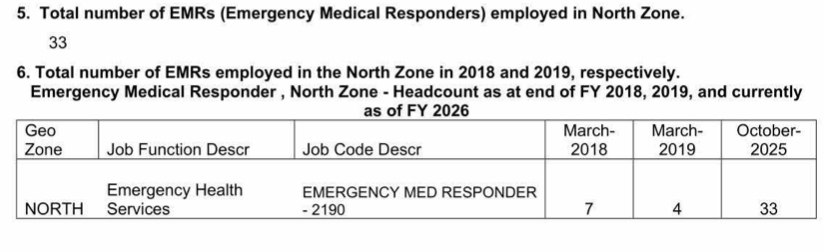
Now let’s fast-forward a few years. Same city. Same system. Same promises echoing faintly in the background. What do we get? An explosion of EMR usage on ambulances, to the tune of 675 shifts filled by EMRs in 2024–2025 alone. So much for “no degradation of service.” Turns out the promise wasn’t broken , it was quietly buried, paved over, and rebranded as “innovation” to address a staffing crisis born of managerial ineptitude!

Lets also bare in mind that for the former years, those being 2018, 7 EMRs were employed in the zone, and 2019 had only 4! But today? There are 33 who augmented those 675 shifts.
Is that the end of the bad news for the North Zone?
North Zone.... It somehow got worse. Oh, you sweet summer child.
Let’s talk about unfilled shifts. And once again, let’s return to the beating heart of North Zone dysfunction: Grande Prairie, our ever-reliable test subject. Because if things are bad there, they’re bad everywhere, just with fewer FOIP pages to prove it.
When we asked a very simple question, how many ambulance shifts went unfilled? the answer didn’t come back as a neat little spreadsheet or a reassuring executive summary. It came back as 25 pages of ambulance shutdowns. For one city. Let that sink in.

Those pages represent roughly 2,500 vacant shifts. Which, translated out of corporate-speak and into reality, equals the equivalent of 1,250 ambulances taken out of service.
One city in the zone. A system that is apparently “stable”, or as the North Zone leadership allegedly told their staff a year ago that staffing levels were stabilizing but we get this data.
And yet, somehow, this same leadership team wants you to believe they have everything under control. That this is fine. That the plan is working. That this is definitely not their fault.

So what’s driving this problem?
In Grande Prairie alone, when we asked, the answer was 73 vacant full-time positions. Seventy-three. In one city. That’s not a staffing challenge, that’s a system hemorrhage.
By any reasonable measure, that number is astoundingly bad. But it didn’t happen by accident. It’s the predictable result of a managerial culture that managed to take what was once a genuinely great career and grind it down into something people actively flee from.
And that’s the real tragedy here. This could still be a great career if it were managed properly (It isn’t). For some context, since "leadership" loves to shield their incompetence from www.wheresmyambulance.com by saying we post information out of context 73 vacant jobs means that over 27% of Grand Prarie's Ambulances are unstaffed!

This is why we’re seeing EMRs desperately plugging holes in “leadership’s” sinking ship. But is that the full story?
Oh, not even close.
Grande Prairie has had to rely on 63,737 hours of overtime as of September 30 of this year to fill over 10% of it's hemorrhaging roster. And just to be clear, we’re publishing this in December. That’s tens of thousands of overtime hours before the year was even finished.
Translated into plain language: millions of dollars bled straight out of the province’s coffers. Not for innovation. Not for improvement. Not even for stability. Just to keep the lights on and the wheels barely turning.

And all of this because no one seems willing to address the elephant in the room, namely, that this “leadership” team has been so utterly incompetent, and this EMS system so profoundly dysfunctional, that the idea of it ever running efficiently borders on fantasy.
But sure.Let’s just plug more holes with overtime throw even more money out the window and pray that this system will start running efficiently… Alberta has only been waiting 15 years since a certain Mr. Potato head spearheaded this terrible idea!
You’d think these matters would qualify as a problem. A major problem. The kind of problem where a city might reasonably want to keep all of its ambulances… in the city.
And if municipalities actually had a say, that might even happen.
But as we know, the system this “leadership” team clings to so desperately doesn’t allow for such radical ideas. Instead, it does what it always does: it takes an already strained system and stretches it even thinner.
In 2025 alone, Grande Prairie’s ambulances were relocated out of the city 245 times to cover other poorly staffed communities. That’s not surge capacity. That’s not system flexibility. That’s robbing Peter to pay Paul, except Peter also hasn’t had an ambulance for hours. So while Grande Prairie struggled with shutdowns, vacancies, and staffing gaps, leadership’s solution was simple: take what little coverage remained and ship it somewhere else.
Problem solved.

This starts to really paint a picture it seems!
But hang on, why are all these other communities hurting?
Well, managerial incompetence is the obvious standout. The only thing that rivals it is the system’s rampant dysfunction. And why is it so dysfunctional? Because a follower sent us something very interesting.
Inter-facility transfers.
One of the single biggest plagues on this EMS system, and not because transfers are inherently bad, but because:
There is no accountability placed on facilities for what they do (or don’t) send out the door by ambulance.
There is no meaningful quality assurance to determine who should and who should not be moved between facilities by ambulance, because in this system, apparently, everyone should.
Then this follower sent us the data from their station: Valleyview.
What we saw perfectly illustrates how these two failures combine to cripple the system. Rural hospitals are effectively allowed to function as major system bottlenecks, generating such absurd levels of ambulance usage that suggesting every one of these patients required an ambulance is about as believable as Santa Claus being real, except he doesn’t visit anymore because the Easter Bunny crippled him, and global warming caused the toy shop to slide into the ocean.


In other words: technically possible, but completely detached from reality.
And this is how you break an EMS system, quietly, expensively, and while insisting everything is “within expected parameters.”
To make matters worse, as this follower reminded us, these transfers aren’t exactly quick trips across town. They’re long hauls. Very long hauls. And when you start pulling all the pieces together, it becomes clear this isn’t a one-off problem, it’s a zone-wide one.
These transfers are brutally time-intensive, especially for core-flex units, and the downstream impact is entirely predictable. Over a 13-month period in the North Zone, this translated into 783 ambulances being taken out of service due to fatigue, after crews had worked up to, and often well in excess of, 14 hours.

That’s not resilience. That’s exhaustion being treated as a staffing strategy.
And it gets worse. A paramedic in Peace River told us that crews are often bullied into working past the 14-hour limit, in direct contravention of both the collective agreement and the law.
So when leadership shrugs and points to “fatigue events” as an unavoidable reality, what they’re really describing is a system that relies on coercion, burnout, and rule-breaking to function at all.
Which, incidentally, explains why it keeps failing.
Think that’s all this “leadership team” is up to in its ongoing quest for peak toxicity? Oh no. Not even close. Here’s another quote we received while putting this piece together:
There’s also been multiple people in GP who have been threatened to be sent home unpaid for calling inclement weather and refusing unsafe work during the severe snow storm.. that’s what is what we’re dealing with now
Because, apparently, driving on snow-covered roads in whiteout conditions is, according to this leadership team, extremely safe. Just like shuffling ambulances around the map to cover communities that were originally uncovered due to system incompetence is totally reasonable when conditions are at their worst.
It’s not like we’ve seen tragedies happen here, or in other jurisdictions, because of this exact mentality. Oh wait. We have. https://www.cbc.ca/news/canada/british-columbia/2-b-c-paramedics-found-dead-1.921162 https://globalnews.ca/news/9145852/dallas-boyko-funeral-alberta-paramedic-crash/
And let’s not forget: paramedics have a legal right to refuse unsafe work. But to this leadership team, that right seems to be more of a friendly suggestion. Try to exercise it and suddenly HR gets involved, cue the wide-crazy-eyed at lady from HR to bac up "leadership", clutch-the-policy-manual routine, and you’d better hang on, because an “investigation” is incoming.
Safety culture, North Zone–style: comply, or else. But if something like this happens it's just an operational hazard not an unnecessary safety risk!

So what’s the culmination of all this dysfunction and incompetent leadership in the North Zone?
We asked a simple question: how many ambulances were booked out of service because they couldn’t be staffed properly? The answer we received was… alarming.
One hundred and forty-one pages of shutdowns.A total of 5,781 ambulances taken out of service between October 1, 2024 and September 30, 2025. The list simply too long for us to post here so you can view the list in it's entirety on the AHS FOIP reading room under 2025-AG-179, or if you'd like we can email it to you!
Let that sink in.
And keep in mind, this is all happening while we’re being told allegedly that staffing in the North Zone has “stabilized.” If this is what stable looks like, we’d hate to see what unstable staffing looks like. Is it any wonder this is their attitude though? Rules for thee not for me, so just gas light the Paramedics and hope for the best brought to you by the same people who think stuff like this is appropriate!

So let’s recap.
Over 5,781 ambulances shut down.141 pages of staffing failures.Thousands of vacant shifts.Tens of thousands of overtime hours.Hundreds of fatigue-related out-of-service events.Paramedics bullied past legal limits.And leadership still telling staff, allegedly, that things have “stabilized.”
If this is stability, it’s the kind you find right before structural collapse.
None of this happened overnight. None of it is mysterious. And none of it is unavoidable. This is what happens when incompetence is insulated, accountability is optional, and the solution to every problem is to squeeze harder on the people still willing to show up.
And here’s the part leadership really doesn’t like: this story exists because people supported it. Because followers shared data. Because paramedics spoke up. And because FOIP requests, expensive, tedious, infuriating FOIP requests, dragged the truth into the daylight.
If you think this kind of work matters, if you want this system examined instead of endlessly excused, consider helping us keep doing it. FOIP fees aren’t cheap, servers don’t pay for themselves, and sarcasm, unfortunately, is not tax deductible.
We’ll keep asking the questions.We’ll keep publishing the answers.And if leadership doesn’t like it, they’re welcome to fix the system instead.
Until then:Welcome to the North Zone. It somehow got worse.


Numbers from the Post "Robbing Peter, Paul, and the Entire North Zone"
- **675 shifts**: Filled by EMRs in Grande Prairie in 2024–2025 alone.
- **7 EMRs**: Employed in the North Zone in 2018.
- **4 EMRs**: Employed in the North Zone in 2019.
- **33 EMRs**: Employed in the North Zone today.
- **2,500 vacant shifts**: Represented by pages of unfilled ambulance shifts in Grande Prairie.
- **1,250 ambulances**: Equivalent taken out of service due to the vacant shifts in Grande Prairie.
- **73 vacant full-time positions**: In Grande Prairie.
- **Over 27%**: Of Grande Prairie's ambulances unstaffed due to vacancies.
- **63,737 hours**: Of overtime in Grande Prairie as of September 30,
- **Over 10%**: Of the roster…