“Borderless, Brainless: How EHS Flexes Ambulances Instead of Thinking”


Their “Research” Doesn’t Support Paramedic Care
This feels almost unfairly easy.
Hypothesis:If there’s no emergency, there’s no reason to turn a wheel.
Too simple? Fine.
Revised Hypothesis:If the trip is non-urgent and the weather looks like the opening scene of an Arctic survival documentary, maybe, just maybe, there’s no reason to turn a wheel.
Let’s test this radical concept with a few real-world examples.

Example 1
Mary is admitted to a rural hospital. She needs an orthopedic exam and a routine cast change in an urban centre. It’s -40°C, there’s a whiteout, and the highway looks like a snow globe someone shook aggressively.
Question:Does Mary really need that cast changed today, at the risk of:
a. The ambulance ending up upside-down in a ditch.b. The only ambulance in Mary’s rural community being unavailable for an actual emergency.c. The paramedics not making it back in time to get off shift, again, because “patient flow.”
Spoiler: the cast will still be there tomorrow. Example 2
Hooterville (population: 1,500 and a gas station dog) is 100 km from anywhere.They have no ambulance because, surprise, there are no paramedics willing to staff it.
It’s 0300 hrs.EHS decides the solution is to “flex” an ambulance from Staggertown to Hooterville. Naturally, an ambulance from Peppertree now has to flex to Staggertown, because that’s the protocol.
There is no emergency. The phones are not ringing. Nothing is happening.

So the question becomes:
Do ambulances from Staggertown or Peppertree really need to turn a wheel at the risk of:
a. Being taken out by a drunk driver at 0330 hrs.
b. Paramedics nodding off after their 7th completely unnecessary flex of the shift.
c. Arriving exhausted to an actual HALO event later for that exact reason.
d. Missing shift change, again, because the system demands motion, not logic. But Why Is This Happening?
Ambulances are being over-flexed because EHS:
a. Can’t get paramedic crews out of hospital hallways.
b. Can’t staff ambulances because paramedics refuse to be abused and bullied anymore.
c. Can’t hire fast enough to replace injured, burned-out, retiring, or quitting staff.
d. Can’t manage urban call volumes driven by overdoses and violence.
e. Has managers asleep in their own beds, comforted by the fact they are entirely unaccountable.
The “Borderless System”
The EHS Borderless System is a sham—a confidence game designed to distract from the gross failure of EMS leadership.
“Albertans will always get the closest ambulance.”
Only a fool believes that line explains, or excuses, what’s actually happening.
This so-called “system” is nothing more than a one-way mutual aid agreement:
Not mutual
Not aid
And never willingly agreed to by a single rural municipality or elected council
This is the inevitable outcome of centralized planning by incompetent bureaucrats, many of whom are former paramedics who:
Got tired of working the street
Have no leadership skills
And are desperately trying to keep everything duct-taped together until they can retire or climb one more rung into an even safer office job
That’s the hypothesis.
Prove us wrong.


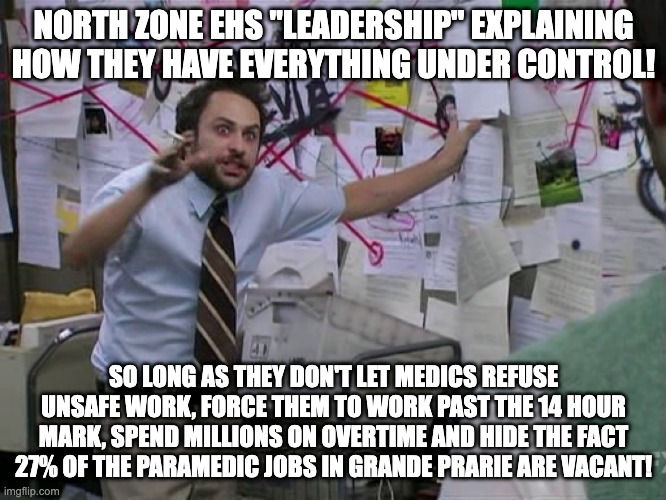
Will they ever understand that even with a fancy "dynamic deployment" computer program, you CAN'T predict the unpredictable