EMS to EHS: The Alberta Ambulance Crisis Built by Leaders Who Always Fail Upward and never get fired.


Once again, we’re back to talk about Alberta’s Ambulance service. And this time, hold onto your hats, because we’ve got fantastic news! Paramedics have a brand-new “leadership” team to go along with their shiny new rebrand. 🎉 Which in Alberta Health Services terms means: same people, same paycheques, just a different title and maybe a LinkedIn post about ‘embracing new challenges.’ You’d think after years of failure someone would get fired, but apparently, in AHS, or EHS land, incompetence is tenured instead of terminated.
Excited? Pumped? Ready for solutions? Sorry to disappoint, but the only thing getting a promotion around here is the person who approved ONE MILLION DOLLARS a month in overtime for each of Alberta's largest cities and still cannot fully staff their Ambulances.
We filed FOIP requests on September 1st and one of our eagle-eyed readers sent in one of their own (because we're now the unofficial transparency office for AHS). What came back wasn't inspiring. It’s a stark look at how far Alberta’s ambulance system has been driven off the rails. The only thing thriving is EHS leadership’s ability to spin failure as success.
If you like what we’re doing, exposing the gaps, highlighting the human cost, holding executives accountable, help us fund more FOIPs that make bureaucrats sweat through their non OH&S compliant shirts! You can support us through the link: https://www.givesendgo.com/GC4M8
Buckle up. It’s going to get ugly. As you read through this ask yourself,
"How on earth have these people kept their jobs when everything they touch fails?"
Now, let’s talk about everyone’s least favourite phrase: “We’re in Red Alert.” It’s been said so many times within EMS (Or is it EHS now? This rebrand’s clear as mud) that the term “Red Alert” has lost all meaning. That’s how far this latest management dream team has taken things, right to the brink of total collapse, miraculously, not a single person responsible has been fired. This like giving the Captain of the Titanic another boat. Who suffers the most under their gold-standard incompetence? Not the leadership team sitting comfortably in Zoom meetings about “system transformation.” No, it’s the patients.
We need to shine a spotlight on the people paying the ultimate price. EHS seems to have become a service run like a group project where where everyone wants to do the PowerPoint but nobody wants to do the WORK. In an earlier post, we discovered that AHS “leadership” can't handle the bad publicity that came with declaring a Red Alert. When there were no ambulances available in Alberta’s biggest cities because Red Alerts happened so often that for an entire summer in 2022 it was referred to as Forever Red. Leadership did what any incompetent bureaucracy does when faced with failure: they renamed it.
They tweaked the parameters, slapped a fresh coat of orange paint on the same disaster, and called it progress. (If you're new to the blog, you can review the previous manipulation in our story: Orange is the New Red.)
So, naturally, we wanted to see how things were going in the lead-up to the big transition from AHS EMS to EHS. Surely the new era was off to a strong start, right?
Yeah. About that. Much to our surprise, and by “surprise” we mean “grim confirmation of everything we already suspected”, Alberta’s two largest cities were not exactly crushing it when it came to Orange Alerts.
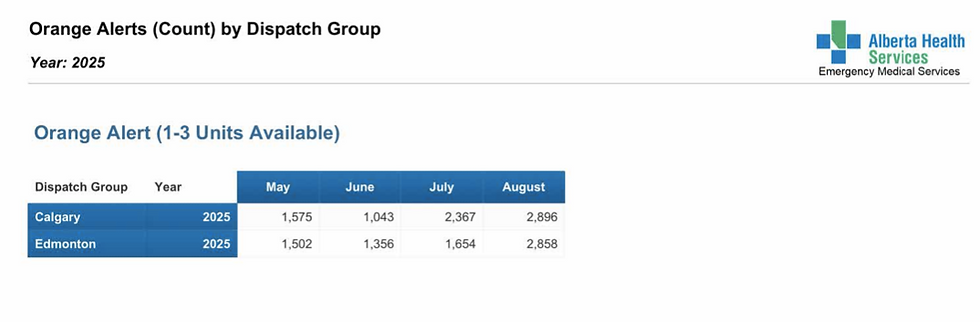
In Calgary, May kicked off with 1,575 Orange Alerts, while Edmonton clocked in at 1,502. Manageable, maybe even hopeful, if you squint hard enough and ignore that the numbers ticked down instead of up. Fast-forward to August, and boom, both cities nearly doubled those numbers. A near 100% increase over 4 months! Truly remarkable. Not in the “well done, team” kind of way, but in the “holy hell, how did you make this worse?” kind of way. Had leadership not been planning weeks, months, heck at this rate even years ahead since they've failed every summer for years? Apparently Not. They did nothing meaningful to stem the tides of Orange Alert increases which we expected again in Summer 2025
Calgary wrapped up the month at 2,896, and Edmonton wasn’t far behind at 2,858.
Most places, doubling your failure rate gets you fired. At EHS, it gets you invited to host another presentation on how exciting this transition is without actually offering real ideas on how things are going to change.
Senior “leadership” team was very busy during that time, telling paramedics, the media, the government, and anyone else who would listen how excited they were about the transition to EHS. In between trips to the Lake of course! Gas Lighting everyone, and expecting to survive another fiscal year without any accountability just like they had when they were buried inside of AHS. Heralding “system stability” with a shiny new acronym and a few talking points polished for town halls around the province where they openly misled councils about their failures. Now it's with people from around the world talking about all the ways they solved EMS problems that Alberta continues to wrestle with. We saw there was ZERO commitment that the ideas these people brought forward would be meaningfully implemented here.
So yes, in all this planning maybe a few minor details slipped through the cracks. Like, say, a near 100% increase in the number of times Calgary and Edmonton were down to one to three ambulances left to cover over two million people. Minor oversight. Could happen to anyone running a multimillion-dollar health system into the ground.
And as glib as we might be about their world-class incompetence, which, frankly, should be studied in universities as how not to run an Ambulance service, (anyone want to ask Royal Roads University if they'd like us to write a syllabus?) it wasn’t funny for the people waiting on the other end of those calls. The ones left sitting on curbs, in homes, and in parking lots while dispatchers scrolled through a province-wide game of “Where the hell is an ambulance?” But don’t worry, likely somewhere there's an executive director getting a plaque for ‘excellence in system transition’ instead of a pink slip.
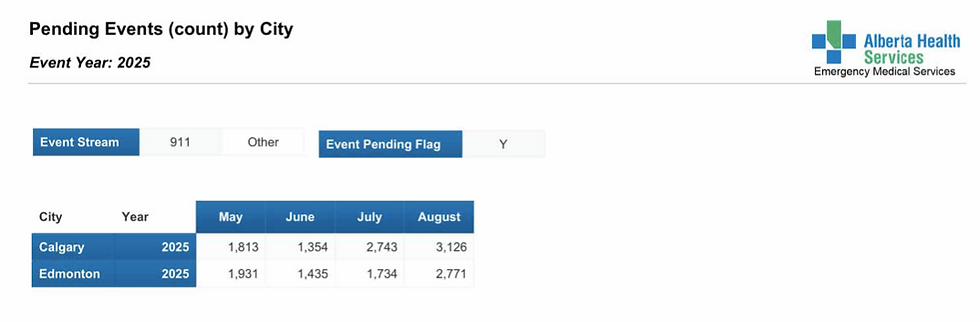
In Calgary, those pending events went from 1,813 in May to a jaw-dropping 3,126 by August. Edmonton wasn’t far behind, climbing from 1,931 to 2,771. That’s not growth, that’s system failure with a fresh coat of corporate optimism. Yet somehow, in the middle of all this chaos, paramedics are told to “trust their leadership team.” You can almost picture the memo: “Ignore the data, ignore the empty Ambulance bays, just keep smiling and don’t forget to fill out your wellness survey!” As if it was not obvious that EHS had existed since April, and on September 1st the only thing that had changed was the name of the organization. Is it any wonder so many Paramedics have quit over the years and the rest have no confidence in management to do anything but fail?
But here’s the reality: those medics who remain, these aren’t the medics who’ve quit, or gone casual, or fled to other provinces for a shred of sanity. These are the ones still showing up, exhausted, burnt out, and desperately trying to keep patients alive while leadership insists everything is under control.
Except it’s not. These aren’t just numbers on a spreadsheet. Behind every “pending event” is a person, a grandmother on the floor, a child in respiratory distress, a man clutching his chest, all waiting, waiting too long at times, because there simply weren’t enough ambulances left to send after this "leadership" team destroyed the moral of the provinces Paramedics.
They’re still busy playing “nothing to see here,” spinning PowerPoint slides about “service optimization” while the people they’re supposed to protect are literally waiting for help that never comes. At this point, the only ones still pretending the ship isn’t sinking are the ones trying to sell tickets for the next cruise. Why? Because everything this "leadership" team touches, or is ordered to do to improve the system is either ignored, or fails without any accountability. Here are some examples:
December 2022 AHS was told to start moving non urgent patients by taxi or shuttle, an initiative that was largely ignored. If Paramedics were to speak up that using an Ambulance for a particular IFT event was inappropriate they'd be reprimended!
February 2023 AHS told everyone they were going to save thousands of Ambulance dispatches by diverting calls to 811. Baked into this plan was all the markings of an initiative that AHS wanted to see fail, and it did, you can read all about on a previous post of ours (https://www.wheresmyambulance.com/post/the-ems-811-shared-response-program-the-fix-that-never-was)
https://www.cbc.ca/news/canada/calgary/ems-811-shared-response-program-1.6735542
This didn’t stop AHS from bragging about their “success” though, because who doesn’t love a good gaslight when the house is already on fire? Nothing says “we value our Paramedics” like public self-congratulation while the CAD notes scream “transport only.” Pro tip - don’t publish victory laps when morale’s already in the basement. Psst… this isn’t how you rebuild the trust you squandered years ago.
https://www.cbc.ca/news/canada/edmonton/ems-811-shared-response-line-hits-milestone-50-000-1.7603792
At this point, the expectation of failure is so high, and morale is so low these paramedics aren’t just hanging on by a thread, they are the thread. They’ve become the living, breathing embodiment of system collapse: running on caffeine, adrenaline, and pure spite. Don't believe us? Well "leadership" they're your staff, ask them! "Are you thinking about an exit plan?" They’re what happens when dedication meets managerial ineptitude head-on.
These aren’t just burned-out workers anymore; they’re avatars of burnout itself, walking symbols of what happens when a system is so broken, so catastrophically mismanaged, that “coping” becomes a full-time survival strategy.
They’re working inside a machine that’s long since stopped functioning, being “led” by people whose main contribution seems to be finding new ways to redefine failure as “innovation.” The dysfunction isn’t an accident anymore, it’s the business model and its performance is highlighted by sick hours.

Calgary hit a new high score in July, racking up 9,020 sick hours, that’s 4.5% of all paid hours. (Remember that number, it’s going to matter later, consider it your foreshadowing.) Not to be outdone, Edmonton went for gold in August, clocking 9,604 sick hours, or 5.6% of total paid hours. Impressive, right? Except instead of Olympic medals, all they’re winning is chronic exhaustion and system collapse.
So why is this happening? Well, let’s take a little stroll down memory lane, all the way back to 2022, when the EMS system was already gasping for air. Remember that? Long waits, burnt-out medics, and a government and “leadership” insisting they had it all under control. Their big fix? An announcement of 20 new ambulances split between Calgary and Edmonton. 🎉 Cue the press releases, ribbon-cuttings, and corporate back-patting. The CBC even ran a headline so optimistic it should’ve come with a laugh track:
“New ambulances, more paramedics announced for Edmonton, Calgary amid EMS strain.”Read it here
There was just one tiny problem, they didn’t actually have enough paramedics to staff them then. Kind of like buying twenty new airplanes without hiring any pilots. But hey, it looked good on paper. That was what failure looked like three years ago. So what’s changed since then? Surely things have improved, right? Nope. The only thing that’s gone up is call volume, and not by a little. The demand has skyrocketed while the workforce has withered, and leadership is still out there talking about “innovation” like it’s a TED Talk the Paramedics are actually paying attention to.
Because in Alberta EMS, the math is simple:

So, call volumes keep climbing, and leadership’s response? Well, let’s do some math.
A new ambulance costs around $1.1 million to put on the road, not counting the overtime, of course, which this management team treats like an opioid dependency, you can read all about it here (https://www.wheresmyambulance.com/post/chasing-the-overtime-high-ahs-ems-s-never-ending-overtime-bender). They just can’t quit it. So, what’s the plan when the system is buckling under the weight of rising demand? Add more ambulances? Hire more staff? Meaningfully address system pressures?
Don’t be ridiculous.
Let’s rewind for context. Back in 2022, Calgary handled 11,806 calls, and the system was already on life support. By the same time this year, that number ballooned to 14,190 calls. Edmonton wasn’t far behind: from 11,562 in 2022 to 14,590 now. That’s not “increased demand”, that’s a full-blown crisis.
And finally, after years of paramedics begging leadership to admit that ambulances aren’t taxis, the lightbulb went on! 🎉
Their solution? Send taxis instead of Ambulances. Almost like the Paramedics were right all along. God forbid "leadership" ever came up with a single original idea, but at least this time they were actually really going to do it right?.
According to a CTV headline, “Patients may be offered a taxi rather than an ambulance in Edmonton and Calgary: EHS.”👉 Read it here.
The irony here could choke a horse. Not long ago, if a Paramedic dared to tell a patient that an ambulance wasn’t a taxi, and a supervisor found out, you could expect an “immediate investigation” for “unprofessional conduct.” With the supervisor marching in the crazy eye'd HR cat lady to oversee the Kangaroo court.
Now? That same management team has rolled out the revised “taxis instead of ambulances” pilot program like it’s some bold new innovation in emergency care. Apparently, when they’re not busy bullying their staff, they’re brainstorming new ways to redefine failure as “efficiency.” Because nothing says “we’ve lost control of our EMS system” quite like outsourcing emergencies to Uber.
The sad part? Behind all the sarcasm, this isn’t funny. It’s the natural outcome of years of denial, mismanagement, and a leadership culture that would rather rebrand a crisis than fix it or god forbid listen to their staff's good ideas before they all quit. Worse still, they continued with the same built in a fail safe that sewered the program last time. Patients can just say, "NO, I don't want a taxi, I want an Ambulance!" just like they could say "no I don't want to talk to 811, just sent me my flashy Uber."

Who would’ve guessed that just a few words, would buy some good will: “patients may be offered a taxi”, then just a few more words would shatter that good will so perfectly: "Client refused taxi" and capture the sheer scale of this leadership failure? It’s like a slogan for the downfall of Alberta’s EMS: “Lowering expectations, one re-dispatch at a time.”
It’s hard to overstate how catastrophic this is. Whatever sliver of goodwill this “leadership” team once had from paramedics has been torched, buried, and paved over with corporate doublespeak.
It’s genuinely sad, not just because it’s embarrassing but because this is what’s become of the Province with the BEST EMS is Canada. Remember when Alberta first took over EMS and “leadership” swore up and down that there would be no degradation of service? That was the big pledge, the rallying cry. Fast forward to today, and not only has that degradation happened, it’s been industrialized. With not dozens, but hundreds upon hundreds of ALS to BLS downgrades across Alberta's two largest cities done to stave off an Ambulance shut down:

The same “leadership” that promised to protect the profession and the service it provides has spent the past 16 years grinding it into dust. The last decade has seen a mass exodus of Paramedics, pre-hospital professionals who proudly called this a career. Many sustained permanent injuries before they quit, leaving ambulances unstaffed, shifts uncovered, and patients waiting in record numbers.
And yes, leadership will solemnly deny it, issue another press release, hold another town hall and talk about “transformative system evolution.”
But the numbers don’t lie, even if leadership does.
It’s the same song and dance they’ve been performing for years. Remember when they told rural communities that centralizing EMS would improve their service to communities?
That they’d have better coverage, faster response times, and more resources?
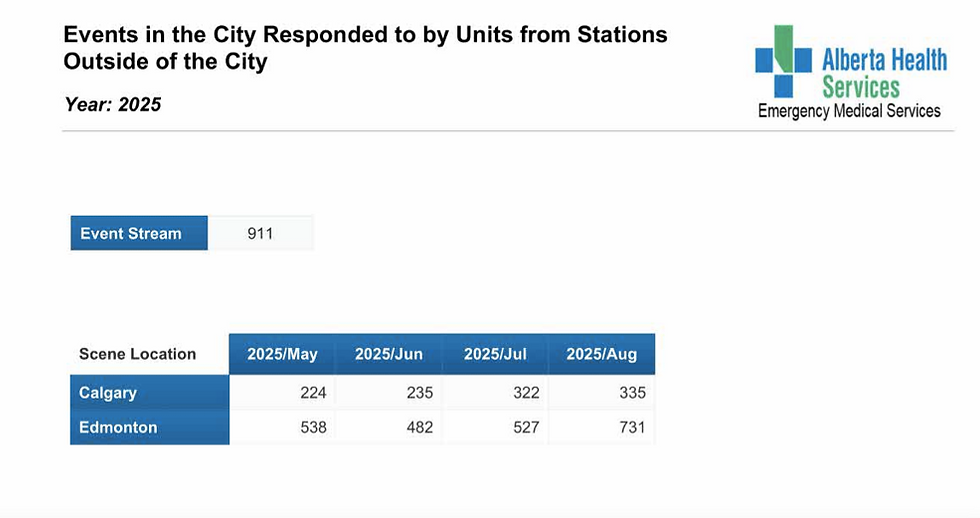
In reality, the opposite happened. Rural ambulances are now being pulled into the cities so often it’s part of their daily routine. It’s like they’ve reinvented the concept of “metro coverage”, only with extra steps, longer drives, and less sleep at the end of a busy shift.
And sure, leadership insists, “Oh, we’re doing that less and less!” As if that’s comforting. When you’re still doing it hundreds of times, that doesn’t make it better, it just makes it routinely bad, 'maybe in a few years we'll barely do it all.... but not for a few years, sorry not sorry' level gaslighting there.
The fact that the number of relocations is in the hundreds should be the headline. Rural ambulances weren’t meant to be Calgary or Edmonton’s backup plan, but that’s exactly what they’ve become. Communities are left exposed, patients are left waiting, and the only thing “improving” is the creativity with which leadership tries to spin it:

At this point, you might be asking, “Okay, this all sounds terrible, but why is this happening? Where are all the ambulances?”
Surely, they can’t all be tied up on calls all the time, right?
Well… yes and no. Here’s where things get truly sinister.
Because you’re right, the ambulances aren’t always screaming from one end of the city to the other. The real problem is far worse: EMS has been designed to fail, in order to protect the poor performance of Hospitals. Intentionally or not, it’s now set up so that when paramedics aren’t running calls, many of them are trapped in the world’s most expensive waiting room, the Emergency Department Hallway. We get it, the hospital, they're busy too, but for all the nurses that read this, get angry, and rightly so, IT IS NOT AN EMS PROBLEM THAT THE EMERGENCY DEPARTMENT IS BUSY!
You see, the public tends to view EMS like police or fire: visible, mobile, out in the community, protecting people. Flashing lights, fast responses, saving lives.
But leadership? Oh no. Leadership sees EMS as a glorified hospital holding & shuttle service, the square peg of Public Safety being beaten into the round hole of Hospital health care. Once Paramedics arrive at triage with a patient they’re no longer a first responder, they become hostages in the hallway.
When the hospitals back up (which they always do), ambulances line up outside like the skinny kids waiting to be picked for baseball teams. The whole public safety apparatus gets parked in a hallway because “the hospitals are busy.” In this hospital-centric system it isn't EMS leadership calling the shots. This is their only legitimate excuse for failure because they've lost control of their EMS resources. To the Hospital, patients waiting for care in the hallway are more important than patients trapped in an overturned car, lying at the bottom of a 40' ladder or having a heart attack in their living room. Simply put they are not in the hospital, so they are not our problem is the mantra of hospital management.
"We're all on the same team", say hospital staff to Paramedics waiting in the hospital hallway for hours. Paramedics wonder why they never see ER staff on their team... at a construction site in -30 degree weather with critical trauma patient. In Alberta, Patients in the Community take a back seat to Patients on Hospital Property. Therefore, Paramedic hallway care is the name of the game. Even if it leaves NO AMBULANCES AVAILABLE.
This isn’t a new problem, it’s a chronic one that began in 2006. Let’s take a another trip down memory lane to a 2023 Calgary Herald story, boldly titled:
“Major EMS improvements should be complete in a year, according to AHS, province.”Read it here
One line in particular stands out:
“In that time, meeting a target of a 45-minute patient handover time for paramedics at hospital emergency departments will also be pursued.”
Forty-five minutes. That was the goal. Not one hour. Not two hours. Forty-five minutes. So how then is that going? It's... checks date, 2025, surely theres been some meaningful drive towards this, but no:
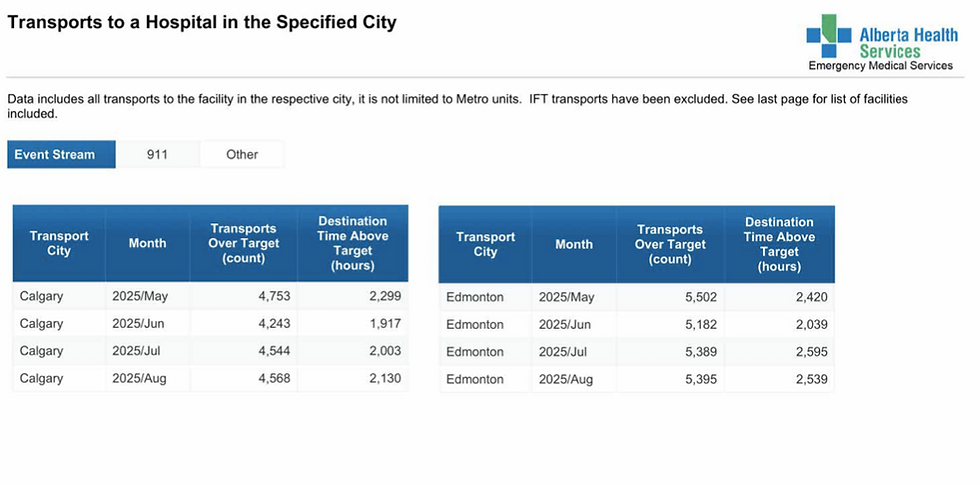
So, let’s talk “best case scenario” metrics.
In Calgary, leading into summer, the hospitals managed to rack up 4,243 patient handovers that exceeded the 45-minute benchmark. Edmonton? 5,182. And yes, these are the best numbers they could show. Imagine calling that a win.
But wait, EHS has an “ace up their sleeve”: the Urgent Download Trigger. Their fail-safe, their 'let’s get these ambulances back on the road' button. Sounds good, right?
Except here’s the kicker: all summer long, they only used it 133 times in Calgary and 102 times in Edmonton. That’s not exactly EHS leadership taking charge. That’s EHS leadership politely ignoring the problem while waiting for something else to happen and hoping the hospitals won't get mad at them.
So the question becomes: who’s really in charge here? The public safety mandate, or the hospital hallway mentality that treats EMS like it’s just another piece of furniture in the ER?
Hint: if patients and Paramedics are left waiting while these numbers are recorded as “success,” you already know the answer.

So where does all this leave us?
All this dysfunction, all this burnout, all those paramedics screaming, “I AM DONE!”
You might remember a few months ago when we sent in a FOIP request asking how often staffing fell below certain thresholds, and the response? “Pay $1,500 and we’ll tell you.” Because nothing says transparency like a paywall. But would that stop us? Heck no.
So we did what actually matters: we talked to paramedics all summer. And what we learned is that come the weekends, staffing doesn’t just dip, it crashes spectacularly.
So we asked AHS specifically about weekends. And oh boy… they did not disappoint. And at the same time, they did.
In Calgary, the average staffing for a weekend night shift had ambulances at 74.8% staffed. Translation: every weekend night, a quarter of the fleet sits vacant. And yes, they included PRUs in that number, the units that cannot transport patients. Remove those, and staffing drops below 30% of transport-capable units.
On August 23rd, it was even worse: only 58.9% of the fleet was manned, including PRUs. Think about that for a second. Over half the ambulances that could actually transport patients were sitting empty while people waited.

Edmonton? Not to be outdone, they averaged 82% staffing, with a low of 75.4% including PRUs. Bravo, Edmonton leadership, you only suck just enough that a quarter of your staff vanish, versus Calgary’s near 30% of transport-capable units unmanned. Innovation at its finest. Worse than that? By their own numbers they cannot even blame sick calls for all of this madness because sick calls only make up for less than 6% of lost work hours in both cities as we covered earlier! The best they'll have is to scream "out of context!" & "Don Sharpe posts freedom of information requests out of context...!" Because the Paramedics are certainly not sick of being gaslit.

No wonder paramedics have zero faith in leadership. And yet, somehow, leadership has infinite faith in itself. Maybe because no one ever gets fired for their managerial ineptitude.
If you ever needed a crystal-clear indictment of failure, dereliction of duty, and utter incompetence, here it is. This is what happens when a “leadership team” treats the EMS system like a game of musical chairs, except the music never stops and patients are the ones left standing.
So where does all this leave us? After months of digging, talking to paramedics, filing FOIPs, and watching leadership spin the same failure over and over, one thing is clear: Alberta’s EMS system is in a state of catastrophic dysfunction.
The paramedics who remain are stretched to the breaking point. Ambulances sit empty. Patients wait. Rural communities are sacrificed to prop up urban centers. And leadership? They continue to redefine failure as “innovation,” treat patient safety like a secondary concern, and rely on spin, rebrands, and press releases to cover up the collapse.
This isn’t a temporary glitch. It’s not an isolated weekend problem. It’s a systemic, decade-long erosion of service, expertise, and trust. The proof? The hundreds of paramedics have fled.
Ambulances are unstaffed. Sick hours and burnout are at record levels. Calls go unanswered. And the response from those in charge? More rebranding. More acronyms. More talking points. And now, apparently, taxis instead of ambulances, but only if the patients wants.
Let that sink in. People waiting for life-saving care may have to wait longer because someone offered a cab for their stubborn fibromyalgia but declined it because the Ambulance would be faster. This isn’t sarcasm, it’s the reality that "leadership" created through years of neglect, denial, and incompetence.
Alberta’s EMS isn’t just in crisis. It’s in free fall. And until leadership is held accountable, until paramedics are supported, and until patient care is treated as more than just a spreadsheet metric, nothing will improve.
This post is a record. A warning. A chronicle of failure. And for the patients, paramedics, and communities who rely on this service, it’s a call to wake up and demand better, because the system, as it stands, is failing everyone it was designed to protect, and benefits only the systems "leadership" who are never held accountable for any degree of failure. So maybe the real rebrand here isn’t EMS to EHS. Maybe it’s ‘Employment: Highly Secure’, because no matter how bad it gets, leadership’s the only thing in Alberta Health Services, or Emergency Health Services, or whatever they're calling it these days that’s truly staffed 100% of the time. Paramedics? too bad for you!
Thanks for reading and if you want more of this please consider a donation to our give send go! https://www.givesendgo.com/GC4M8


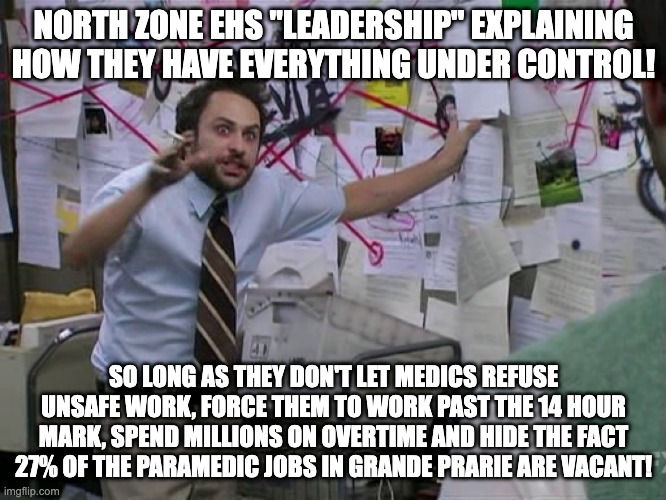
Don't forget about ALS Unit's turning into NAT unit's because..well.. no one showed up.. and SCC/NCC/CCC Running with bare minimum staff on a good day.. Oh wait.. They're on 'training'.. mmhmm.. yep.