Lights, Sirens, and Systemic Failure in Foothills county


Before we dive into this completely normal, totally reassuring, definitely-not-on-fire situation, a quick note: none of this information just magically fell out of the sky. It took time, persistence, and a frankly unreasonable number of Freedom of Information requests to pry it loose.
Turns out, transparency isn’t free. (Shocking, we know.)
So if you enjoy deeply uncomfortable facts, eye-twitch-inducing statistics, and the kind of investigative work that makes bureaucracies sigh heavily and reach for another coffee… you can help keep it going. There’s a GiveSendGo set up to cover the cost of FOIP requests, because apparently “just telling the public what’s happening” is still behind a paywall.
If you’d like to chip in, fund more digging, and help drag a few more receipts into the daylight, you can do that here:https://www.givesendgo.com/GC4M8
Think of it as crowdfunding accountability. Or sponsoring your favourite ongoing episode of “What On Earth Are They Doing?”
Now, with that out of the way, let’s talk about a system that has somehow turned “emergency response” into a province-wide game of musical chairs… except the chairs are ambulances, the music never stops, and the people left standing are, unfortunately, the ones having the worst day of their lives. “Robbing Peter to pay Paul” is one of those phrases that sounds quaint until you realize it’s basically the financial equivalent of shuffling deck chairs on the Titanic. It means taking from one place to fix another, solving a short-term problem by quietly creating a brand-new one somewhere else. In other words: congratulations, you’ve accomplished absolutely nothing, just with extra steps.
At best, it’s a temporary bandage. At worst, it’s a slow-motion train wreck dressed up as “strategy.” Medium to long term? It’s not just useless, it’s actively dangerous. Fixing the underlying problem would require things like planning, foresight, and competence… which, naturally, puts it just out of reach for EHS “leadership,” who seem to cling to this approach like it’s a personality trait.
And nowhere is this more painfully obvious than in the practice of flexing ambulances.
This isn’t some isolated issue you can politely ignore by changing the subject. It’s province-wide. Everywhere you look in Alberta, it’s the same story on repeat. But when residents from Foothills County started asking where their ambulances were, we figured, surely, there must be a reasonable explanation.
There wasn’t.
What we found instead was a masterclass in “Robbing Peter to pay Paul,” except Peter lives in your town, Paul lives somewhere else, and somehow both are still waiting for help.
Let’s talk numbers, because nothing says “functional system” like statistics that make your eye twitch.
In 2025 alone, Okotoks ambulances were sent to Calgary 588 times. On top of that, they were told to relocate to High River another 445 times. That averages out to 2.83 times per day, every single day, before we even factor in additional relocations to Diamond Valley. This is a town of nearly 34,000 people, operating with just two ambulances, which are apparently more familiar with the highway than their own community.
And it doesn’t stop there, because when poor decisions stack up, they don’t just sit quietly; they cascade.
High River, which is supposed to have priority coverage, sent its ambulance to Okotoks 247 times. Diamond Valley? 385 times. Priddis? A staggering 690 relocations to Diamond Valley, plus 90 to Cochrane and 188 to Okotoks, because why not just send everyone everywhere and hope for the best? That’s more than twice a day. Nanton, not even in Foothills County, got dragged into the chaos too, sending its ambulance to High River 578 times.

At this point, “coverage” is less a plan and more a game of musical chairs, except the music never stops, and someone always loses.
Now, you can practically hear EHS “leadership” warming up their usual defense: “You’re taking the data out of context.” Right. Of course. So let’s add context.
If you measure how often ambulances are actually available in the communities they’re assigned to, the results are… sobering. Okotoks’ two ambulances? Available locally just 46% and 48% of the time. High River: 49%. Diamond Valley: 55%. Priddis: 46%.


So across Foothills County, the system manages to get it right about half the time. Flip a coin, that’s your emergency response strategy. Imagine showing up to your job and performing correctly 50% of the time. You wouldn’t have a job. Somehow, here, it’s presented as acceptable.
But maybe, just maybe, we’re being unfair. After all, ambulances do leave their communities to respond to emergencies. That’s kind of the job. So let’s look at call volumes.
In Okotoks, emergency calls rose from 1,954 in 2018 to 2,344 in 2022, a nearly 20% increase. In response, coverage was improved (briefly) to two 24-hour ambulances. Great. Progress. Except by December 10, 2025, calls had already reached 2,722. Project that to year-end and you’re looking at roughly 2,888 calls, a 23% increase, with zero additional resources.
So demand goes up. Resources stay the same. And somehow the plan is… to keep shuffling ambulances out of town. Brilliant.
Meanwhile, other communities aren’t exactly quiet: Diamond Valley had 1,237 calls, High River 1,690, and Priddis 668. But sure, let’s pretend everything’s fine.

At one point, an MLA was told by EHS “leadership” that flexing only happens because of hospital offload delays. Which is interesting, because the data suggests that’s, at best, a partial truth, and at worst, a very confident lie.
Yes, offload delays are real. In fact, 65% of Foothills County ambulance transports to Calgary exceeded the province’s 45-minute benchmark. That’s 1,072 delays out of 1,639 transports, and that’s not even the full year. Thirty-three pages of delays, and counting.
So yes, delays are a problem. But they’re clearly not the problem. They’re just one more crack in a system that’s already falling apart.

And when systems fall apart, people pay the price, especially the ones holding them together.
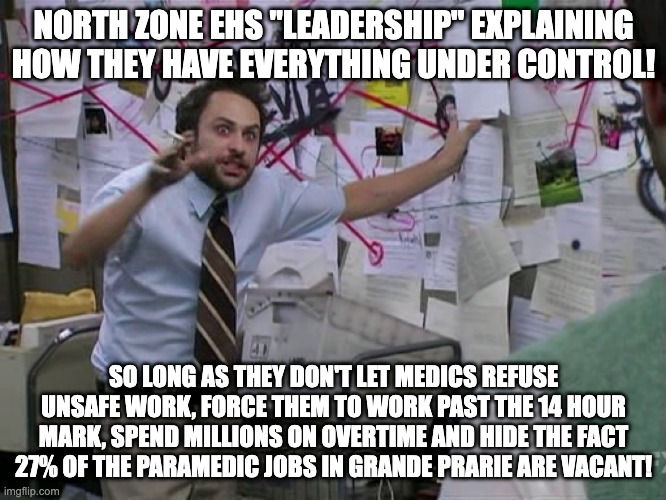
Paramedics are left exhausted, frustrated, and, unsurprisingly, increasingly absent. Burnout leads to sick calls, which leads to staffing gaps, which leads to ambulance shutdowns.
In 2025, Okotoks lost one of its two ambulances entirely 51 times. Priddis lost theirs 21 times. Diamond Valley: 6. High River: 11.

Because nothing improves emergency response times quite like having fewer ambulances.
To “mitigate” this, leadership allows Advanced Life Support units to be downgraded to Basic Life Support. Translation: the same ambulance, but with fewer capabilities. It’s not a solution so much as a polite lowering of expectations.
This happened 77 times in Okotoks, 55 in High River, 30 in Diamond Valley, and 36 in Priddis. It’s functional, in the same way duct tape is a structural engineering material, technically useful, deeply concerning.

And then there are the “innovations.”
You’ve probably heard the talking points: calls redirected to Health Link (811), taxis instead of ambulances, efficiency, modernization, buzzwords flying like confetti at a parade no one asked for. Between September 2025 and December 2025 a mere 1163 calls were intercepted and sent to 811, well we suppose that is an admirable number, but the devil is in the details right?

We uncovered of this initiative early on over 60% of calls sent to 811 end up bouncing right back to 911. So that’s not solving demand, it’s just adding an extra step and a bit more delay for fun.
And taxis? In Calgary, they managed to send exactly 21 people by taxi.
Twenty-one. Between October 2 and December 10th you’d think they’d have better numbers to celebrate but that’s all “leadership could claim, 21.
Out of an entire system under strain.
If that’s the big solution, then the bar isn’t just low, it’s underground.

At the end of all this, what you’re left with is a system that isn’t solving problems, it’s redistributing them. Communities lose coverage to prop up other communities, which then lose coverage to prop up others, and on and on it goes in a loop of inefficiency.
“Robbing Peter to pay Paul” would imply that at least Paul benefits.
Here, it seems like Peter, Paul, and everyone else are all just… waiting.


Comments